
Burnout and Addictive Behaviours in Executives: When Coping Becomes the Problem
By Dr. Amrit Kaur, PhD
Clinically reviewed by Dr. Terry Spokes, Clinical Director. Last reviewed October 2026.

Dr. Amrit Kaur
Dr. Amrit Kaur is a clinical psychologist who has worked with clients in the United States and the Asia Pacific since 2009, mainly leaders, executives and legal professionals. At The Winslow, she runs groups and provides psychotherapy for clients and their families, drawing on short-term psychodynamic psychotherapy and somatic approaches. Read her full profile.
A client of mine, whom I will call Daniel, once described himself as drinking “like a lawyer, not an alcoholic”. A senior partner in his late forties, meticulous and well regarded, he drank at client dinners, at closing celebrations and in hotel bars after hearings in Hong Kong.
Only in our third session did he mention the bottle he kept in his study, or admit that he could no longer get through a Sunday without it. He had never been drunk at work, and to him that was proof he was “fine”.
Daniel’s story is a common one. Many senior professionals do not arrive saying they have a problem; they arrive saying they are tired and overwhelmed. Two glasses of wine in the evening quietly become four. A sleeping tablet first taken on a night flight to London becomes a nightly habit. Burnout and addictive behaviour often appear together, and one can look like the solution to the other.
Daniel and the other clients described in this article are composites, each drawn from several people, with professions and identifying details changed.
What is burnout?
The World Health Organization describes burnout as a syndrome resulting from chronic workplace stress that has not been successfully managed. In practice, it tends to show up in three ways.
First, there is exhaustion that rest does not fix. A weekend off used to be enough. Now Saturday is spent recovering and Sunday dreading Monday, and the benefit of a holiday is gone within days of getting back. People describe waking up already tired, or a heaviness in the body that sleep does not touch.
Second, there is a growing distance from work. Things that once held their interest start to feel like tasks to get through. They become short with their teams, impatient with clients and less present at home. Many say it feels less like unhappiness than numbness, as if they are going through the motions and have forgotten why any of it mattered.
Third, there is a sense of becoming less effective. They read the same email three times without taking it in. Decisions that used to come easily take effort. They work longer hours and still feel behind, and they begin to wonder whether they are as good at their job as they once were. This is not a weakness of character. People burn out when they have been asked to give more than they have, for a long time, without enough chance to recover.
In executives, the drop in effectiveness is usually the last thing anyone else notices. The work still gets done and the deal still closes. Colleagues do not see the three glasses of wine needed to come down afterwards, or the tablet that makes sleep possible.
How common burnout and addiction are in Singapore
Burnout is widespread in Singapore’s always-on work culture. In Employment Hero’s 2024 survey of 1,018 employees in Singapore, 61% said they had felt burnt out because of work in the previous three months.
Diagnosable alcohol problems are far less common, but that offers executives little reassurance. The 2016 Singapore Mental Health Study found that 4.1% of adults had met the criteria for alcohol abuse at some point in their lives, and that more than nine in ten people with an alcohol use disorder (95.3%) had never spoken to a doctor or other professional about it.
Professions under sustained pressure appear particularly vulnerable. In a US study of 12,825 practising lawyers, one in five (20.6%) screened positive for hazardous or harmful drinking, compared with 11.8% of a broad, highly educated workforce in an earlier study using the same questionnaire. Closer to home, the Law Society of Singapore’s Legal Profession Sustainability Study, published in June 2026 with 855 respondents, found that well-being, particularly mental health, was the strongest factor in whether lawyers stayed in the profession, and nearly 36% of respondents reported moderate or severe anxiety.
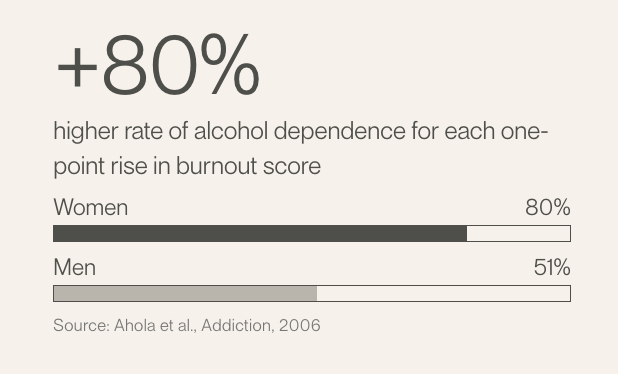
The two problems are closely linked. A Finnish study of 3,276 working adults found that each one-point increase on a burnout scale was associated with an 80% increase in alcohol dependence among women and a 51% increase among men. It was dependence, not simply heavier drinking, that rose with burnout, which suggests that exhaustion erodes the capacity to stop. The study looked at a single point in time, so it cannot show which came first.
How addiction shows up in burnt-out executives
Alcohol
Across Singapore and the region, alcohol is part of professional life: client dinners, celebrations after a closing, entertaining on business trips to Jakarta or Bangkok. Because drinking is expected, escalation is easily missed. Daniel’s drinking began as part of the job. Over two demanding years, the nightcap after a long day became the only reliable way to stop rehearsing the next day’s arguments, and weekends became harder to get through without it.
Prescription medication
Wei Ling, a Singapore-based regional finance director with teams in Jakarta, Manila and Sydney, was first prescribed a sleeping tablet for jet lag. Two years later she was taking it nightly, and adding an anti-anxiety tablet before board meetings. When she tried to stop, she barely slept for three nights and had her first panic attack in years, which she took as confirmation that she could not manage without the medication.
What she was experiencing was most likely withdrawal. The US Food and Drug Administration warns that physical dependence on benzodiazepines, a common group of anti-anxiety and sleeping medicines, can develop within days to weeks even when they are taken exactly as prescribed, and that stopping suddenly can cause serious withdrawal reactions. Coming off them is something to plan with a doctor, not to attempt alone.
Legitimately prescribed medication is among the hardest forms of dependence to recognise, for the person, their family and even their doctors. Wei Ling’s prescriptions came from a GP in Singapore, a clinic in Jakarta and a telemedicine service, so no single doctor had the full picture.
Behavioural addictions
Overall gambling participation in Singapore has fallen, from 52% of adults in 2017 to 40% in 2023, and probable problem and pathological gambling has stayed low and stable at about 1.1%. Participation in illegal online gambling, however, rose from 0.3% to 1.0% between 2020 and 2023. This matches what we see in clinic: for executives, the risk increasingly sits on a phone rather than at a casino, in the form of online betting, cryptocurrency trading, gaming, pornography or spending.
Arjun, the second-generation head of a family business, was referred after his father discovered a six-figure loss on leveraged cryptocurrency positions. He strongly rejected the word “gambling”, preferring to see his trading as a legitimate financial strategy. The pattern, however, was clear: positions opened at 1am after twelve-hour days, rising stakes to win back losses, and a sense of calm only while the market was moving. Trading had become the way he coped with the pressure to measure up to his father and to show “success” in the business.
Work itself
Sometimes work itself becomes the compulsion. Long hours and constant availability are rewarded in most senior roles, which makes compulsive overwork easy to mistake for dedication. It can also do the same job as a substance, keeping difficult feelings at bay until exhaustion makes it impossible to keep going.
Joanne, a technology chief executive in her early fifties, was referred by a cardiologist who could find no cause for her chest pain but had noticed that her drinking had increased. She had not taken a full week of leave in six years, answered messages within minutes at any hour, and became visibly anxious when separated from her phone. She described her evening wine as simply a way to slow down enough to sleep. Over the course of therapy, it emerged that work had long kept painful early experiences at a distance. When exhaustion left her unable to work at her old pace, she turned to alcohol.
Why addictive behaviours take hold during burnout
Using alcohol or other substances to manage burnout can look reckless from the outside. Most people turn to these behaviours not because they are weak, but because, for a while, they appear to work.
Self-medication
The psychiatrist Edward Khantzian’s self-medication hypothesis proposes that people are drawn to particular substances because of their effects on particular kinds of emotional pain. Alcohol quietens a mind that will not stop worrying; sedatives provide sleep that no longer comes naturally; stimulants briefly restore the sharpness that exhaustion has taken away. Daniel, Wei Ling and Arjun each found something that eased their own particular kind of distress.
What chronic stress does to the brain
Prolonged stress weakens the brain systems responsible for pausing, planning and holding back an impulse, while the systems driven by reward and habit become more reactive. My colleague Dr. Terry Spokes explains this balance in his article on cognitive functioning in addiction and recovery. It becomes a loop: exhaustion weakens the capacity to resist, and the behaviour deepens the exhaustion.
Identity and self-worth
Many high achievers have built their sense of worth around performance. When burnout begins to wear away that sense of competence, it can bring up shame or an emptiness that is hard to tolerate. The addictive behaviour relieves these feelings quickly and privately, without anyone else needing to know.

The warning signs
Whether the concern is for yourself, a partner or a colleague, these signs are worth noticing:
- Needing a drink, a tablet or a particular activity to switch off after work or to fall asleep
- Using more, or more often, than a few months ago
- Becoming defensive or evasive when the subject is raised
- Using a substance before meetings, flights or social events in order to get through them
- Work performance holding steady while health, relationships or finances deteriorate
- A recurring sense of having “earned” a drink or a tablet after a demanding day
- Coming back from business travel in noticeably worse shape
Spouses and partners usually notice first. Employers tend to notice much later, if at all, because work performance is typically the last thing to slip.
Both burnout and addiction are treatable, and in my experience care works best when they are addressed together.
A word of caution before you stop
If you have been drinking heavily every day, please do not stop suddenly on your own. Alcohol withdrawal can cause seizures and a dangerous condition called delirium tremens. Speak to a doctor first: you may need a medically supervised detox. Our page on alcohol dependence explains the signs and the options.
What helps
Confidentiality
For executives, confidentiality is often the first concern, raised before anything else is discussed. At The Winslow, care is delivered within strict standards of medical confidentiality, with clear agreement about what, if anything, is shared with an employer.
Treating both together
A period of leave will not resolve an established addiction, and abstinence alone will not resolve burnout. Good care looks at the behaviour itself, at the feelings it has been medicating, such as exhaustion or anxiety, and at the parts of working life that keep both going. The Finnish researchers made the same point, recommending that treatment for alcohol dependence also include an assessment of working conditions and the management of work-related stress.
The right level of care
For some people, weekly outpatient therapy is enough. For others, a period of residential treatment gives the distance and structure needed to recover. This is particularly true where there is physical dependence, repeated relapse, depression or anxiety alongside the addiction, or a home and work life that makes change very difficult.
At The Winslow, the programme runs for 16 weeks: a 28-day residential stay, which is often extended by one to four weeks, followed by a 12-week intensive outpatient programme that keeps support in place through the higher-risk period after discharge.
Involving the family
Addiction affects the whole family. Partners and children often carry a heavy load, frequently in silence, and recovery tends to hold better when they receive support in their own right rather than simply being asked to keep watch over the person in treatment.
Planning the return to work
Going back to an unchanged workload, travel schedule and round of client entertaining puts recovery at real risk. Those changes are best planned before the return to work, rather than after a relapse.
For employers and colleagues
Where there is concern about a colleague, a caring conversation is more likely to help than an ultimatum. Juliana Pang’s article Leading with Love: Starting the Conversation on Residential Treatment offers practical guidance on how to begin.
What to expect
Recovery from burnout and addiction is gradual, and it rarely runs in a straight line. Energy, sleep and concentration can take months to return after the drinking, medication or behaviour has stopped, and setbacks are common, particularly in the first months back at work. A setback is a reason to adjust the plan, not proof that recovery has failed.
A final word
Burnout is a signal that something has to change. Addictive behaviour is often an attempt to avoid changing it. For Daniel, drinking was a way to keep going without ever slowing down. Things began to shift when he stopped asking whether he had a problem and started asking what the drinking was doing for him. Recognising that pattern early is not a sign of weakness; it is often the point at which real recovery becomes possible.
Talking to us
If you are concerned about yourself, a partner or a colleague, you can read more about our programme or speak confidentially with our clinical team. We are happy to talk through whether The Winslow is the right fit and, if it isn’t, to help you find the level of care that is.
Sources: World Health Organization, Burn-out an “occupational phenomenon”: International Classification of Diseases; Employment Hero, Wellness at Work Report 2024 (Singapore); Subramaniam M, Abdin E, Kong AMC, et al. Differences in the prevalence and profile of DSM-IV and DSM-5 alcohol use disorders: results from the Singapore Mental Health Study 2016. International Journal of Environmental Research and Public Health. 2023;20(1):285; Krill PR, Johnson R, Albert L. The prevalence of substance use and other mental health concerns among American attorneys. Journal of Addiction Medicine. 2016;10(1):46–52; Law Society of Singapore and Anthro Insights, Legal Profession Sustainability Study; Ahola K, Honkonen T, Pirkola S, et al. Alcohol dependence in relation to burnout among the Finnish working population. Addiction. 2006;101(10):1438–1443; US Food and Drug Administration, FDA requiring Boxed Warning updated to improve safe use of benzodiazepine drug class.; National Council on Problem Gambling, Report of Survey on Participation in Gambling Activities among Singapore Residents, 2023; Khantzian EJ. The self-medication hypothesis of substance use disorders: a reconsideration and recent applications. Harvard Review of Psychiatry. 1997;4(5):231–244; Sinha R. Chronic stress, drug use, and vulnerability to addiction. Annals of the New York Academy of Sciences. 2008;1141:105–130.