
Why Treatment and Recovery
Take Longer Than 28 Days
By Peter Hayton
Clinically reviewed by Dr. Terry Spokes, Clinical Director. Last reviewed November 2026.

Peter Hayton
Peter Hayton is an Australian psychologist with more than 25 years’ experience in psychotherapy and design of addiction treatment programmes. For eight years, he was founding Clinical Director of The Banyans, a private residential addiction treatment centre in south-east Queensland. At The Winslow, Peter helps clients build resilience and rediscover great health during their residential stay.
Anyone who has struggled with dependency or addiction will tell you that recovery takes longer than 28 days. Addiction builds over years, shaping habits, relationships and emotional life, and it does not loosen its hold on a set date.
Even so, a month has become the familiar shape of residential treatment around the world. That first month matters a great deal, and we think it is worth getting right. But the more useful question for anyone considering treatment is what happens after it.
The Winslow’s programme runs for 16 weeks: a 28-day residential stay, followed by 12 weeks of intensive outpatient care. This article explains what the evidence says about that first month, why the weeks after it matter just as much, and where the evidence is less certain than we would like.
Where 28 days came from
At a recent national addiction conference, someone told me that their partner had worked in some of the earliest US programmes in the 1950s. Their understanding was that the 28-day stay had more to do with how those facilities and programmes ran than with what clients needed.
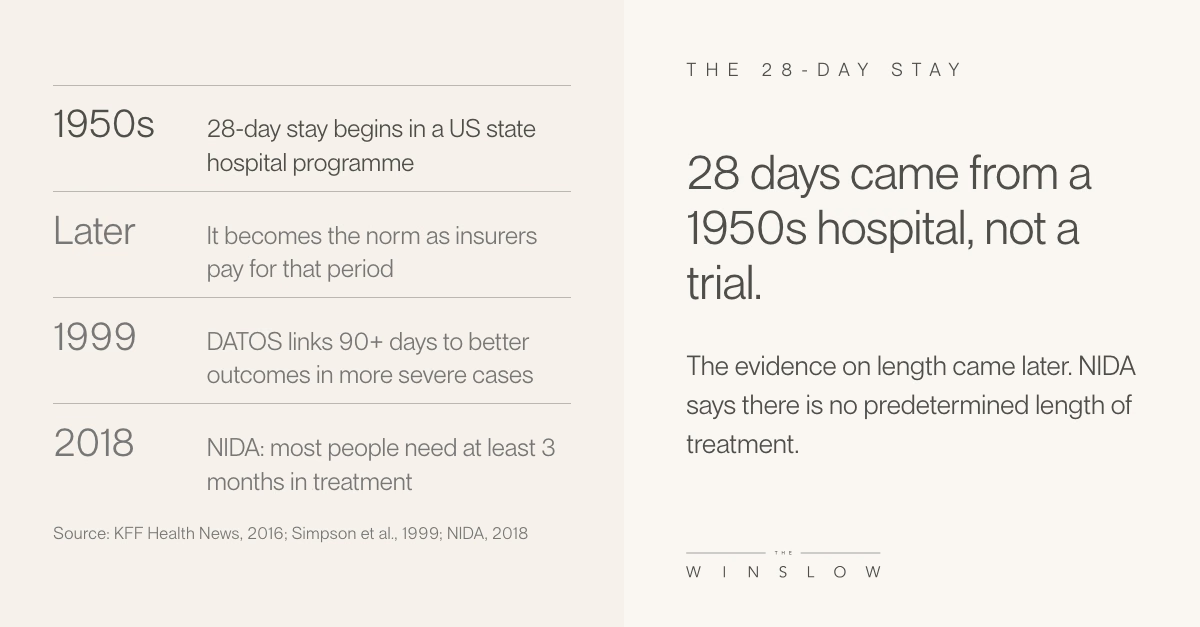
The published history is broadly in keeping with that. US reporting traces the model to a state hospital programme of the 1950s, designed to help people with alcohol problems get sober and leave the hospital, and it became the norm in part because insurers were willing to pay for that length of stay. The director of the US federal Center for Substance Abuse Treatment told KFF Health News in 2016 that there was “nothing magical about 28 days”. That does not make the first month arbitrary. It does mean its length was not set by evidence about how long recovery takes, so we have to look at that evidence directly.
What the first month can do
A month in a residential setting gives a strong start to anyone trying to change an entrenched behaviour or pattern of substance use. Even when the aim is to cut back rather than stop altogether, the brain and body need a real break: not just detoxification, but time away from the substance or behaviour itself.
Dr. Anna Lembke, professor of psychiatry at Stanford University School of Medicine, is a strong advocate of about four weeks of abstinence as a way to begin resetting the brain’s reward pathways. She describes a typical pattern from her clinical experience: people feel worse before they feel better, with withdrawal often lasting around 10 to 14 days, things starting to lift in the third week, and most people feeling considerably better by the fourth. It is a clinician’s observation rather than a rule, but it builds on a long-standing idea. Solomon and Corbit’s opponent-process theory, published in 1974, proposed that strong emotional states are automatically followed by an opposing state. In addiction, that opposing state is the discomfort that follows when the substance wears off.
Research supports the shape of this first month. In a US study of 191 men in inpatient treatment for alcohol dependence, all without a pre-existing major psychiatric disorder, 42% had clinically significant depression on admission. By week four, 6% did, with the largest improvement at week two. The study is an old one and included only men, but its finding remains useful: much of the low mood seen on admission can lift within weeks of stopping.
A caution is needed here. Withdrawal from alcohol and from sedative medicines can be dangerous and requires medical care, which is why, when it is needed, detox takes place before our programme begins, in hospital or at The Winslow.
What the first month cannot do
Feeling better is not the same as being recovered, and this is where a 28-day view can mislead. A 2010 review of alcohol dependence by Heilig and colleagues noted that low mood and anxiety abate over three to six weeks of abstinence in most patients, while the risk of relapse persists long beyond that period. The reasons appear to lie in subtler changes in how emotion and stress are processed, which continue long into abstinence.
Brain imaging points the same way, over a longer timescale. In a small study of five people recovering from methamphetamine use, Dr. Nora Volkow and colleagues measured dopamine transporters, proteins used as a marker of the brain’s dopamine system. Levels rose by 19% and 16% in two brain regions between short abstinence (under six months) and protracted abstinence (12 to 17 months). Motor and memory tests improved less, and not significantly, which suggests that function may take longer to return than the scan alone would imply. Five people using one drug cannot speak for everyone, but the finding is a useful reminder that months, not weeks, is the relevant scale.
Why the setting matters
Because the first month asks so much of people, we support the brain and body in several ways at once. Our residential programme brings together psychiatric assessment and medical care, 24-hour nursing, one-to-one and group therapy, and neurorehabilitation, including TMS (iTBS), an optional, non-invasive form of brain stimulation, and EEG neurofeedback, which reads brain activity in real time. Clients also take part in structured exercise, and in workshops on sleep, hydration and nutrition alongside a balanced meal plan with gut-health support.
Equally, a caring and safe environment is essential to helping regulate psychological and neurobiological systems. Singapore is one of the safest cities in the world and has some of the most well-developed medical services in the region. The Winslow’s purpose-designed centre provides a restorative setting that supports recovery and positive outcomes. As we can see, there are many important factors to consider when arranging person-centered treatment for dependency and addiction. While time away is important, a strong start in recovery involves much more.
The weeks after discharge
The transition beyond the residential phase is one of the most carefully coordinated and planned components of The Winslow’s treatment programme. Following their residential stay, clients move into intensive outpatient treatment, with in-person services available locally in Singapore, and online available from anywhere in the world.
Here again, The Winslow takes a multidimensional approach, providing support and ongoing treatment through the high-risk period following discharge. A combination of one-to-one counselling, group therapy, and recovery coach check-ins support sustained recovery throughout an intensive 90-day period and beyond.
Without that kind of planning, follow-up often does not happen. In a study of 90,639 episodes of residential treatment for opioid use disorder among US Medicaid enrollees, 62.5% of episodes had no follow-up visit or medication for the disorder within seven days of discharge, and 46.9% had none within 30 days. This is one group, in one health system, but it shows how easily care can stop at the door.
Does continuing care help? The honest answer is yes, modestly. A meta-analysis of continuing care for substance use disorders found a small but significant benefit, both at the end of the intervention and at later follow-up. Anyone who boards a plane can assume there is a safety plan in place. Early recovery deserves the same.
How long is long enough?
Looking at the international development of this type of treatment, we can see how popular 28-day programmes became. By the time the well-known Betty Ford centres were entering their second decade of operation, researchers had begun to demonstrate that 90 days was needed to provide adequate support for recovery (Simpson, D., et al., 1997). This research led the US National Institute on Drug Abuse (NIDA) to recommend 90 days of residential and outpatient treatment, noting that participation for less than 90 days is of limited effectiveness. NIDA also recommended treatment lasting longer than 90 days to achieve significant reductions in, or cessation of, substance use (NIDA, 2014).
The large US Drug Abuse Treatment Outcome Studies, which followed people admitted to treatment in the early 1990s, help to explain where that figure matters most. Among 1,605 people treated for cocaine dependence, weekly use fell from 73.1% in the year before treatment to 23.5% in the year after. Those with few problems at admission did well across treatment types, while better outcomes for people with moderate or severe problems depended on longer stays, of 90 days or more. At five-year follow-up, reductions in cocaine use were linked with longer treatment, particularly six months or more. These were observational studies, so they cannot prove that length alone made the difference, and people who stay longer may differ in other ways.
Our reading of this evidence is not that 90 days is a magic number any more than 28 was. It is that the right length depends on the person, that those with more complex problems tend to need longer, and that the months after a residential stay are part of treatment rather than an optional extra. Our 16 weeks reflect that, and residential extensions of one to four weeks are common, depending on clinical need and progress.
What to expect
It is unrealistic to suggest that years of problematic behaviour can be transformed in a few weeks. Treatment does not end the work of recovery: it starts it. Recovery is not achieved at discharge, departure or graduation, and the brain goes on changing throughout life, for better and for worse.
What treatment can offer is a firm footing. What follows is built through daily choices: attending sessions, practising new coping skills, rebuilding trust, forming new connections, looking after your wellbeing and staying in touch with a supportive community. Progress is gradual and rarely runs in a straight line, and setbacks are a reason to adjust the plan, not proof that recovery has failed. Over time, recovery can become a way of life rather than an episode of care.
Talking to us
If you are exploring treatment for yourself or someone you care about, you can read more about our programme or speak confidentially with our clinical team. We are happy to talk through whether The Winslow is the right fit and, if it isn’t, to help you find the level of care that is.
Sources: Volkow, N. D., et al. (2001), Loss of dopamine transporters in methamphetamine abusers recovers with protracted abstinence. American Journal of Psychiatry, 158(3), 377–382; Heilig, M., et al. (2010), Time-dependent changes in drug craving for alcohol: Cravings, protracted withdrawal, and mood. Addiction Biology, 15(2), 169–184; Solomon, R. L., & Corbit, J. T. (1974), An opponent-process theory of motivation: I. Temporal dynamics of affect. Psychological Review, 81(2), 119–145; Simpson, D., et al. (1997), Treatment retention and follow-up outcomes in the Drug Abuse Treatment Outcome Study (DATOS). Psychology of Addictive Behaviors, 11(4), 294–307; National Institute on Drug Abuse (NIDA), (2014). Principles of drug addiction treatment: A research-based guide. nida.nih.gov; Hubbard, R. L., et al. (2003), Overview of 5-year follow-up outcomes in the Drug Abuse Treatment Outcome Studies (DATOS). Journal of Substance Abuse Treatment; Substance Abuse and Mental Health Services Administration (SAMHSA), Treatment duration and outcomes.